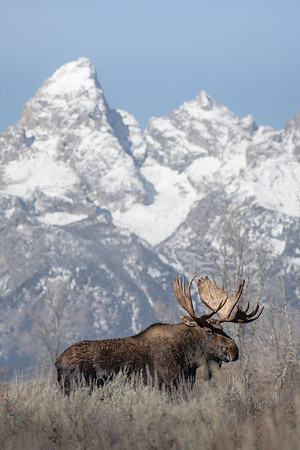
Shoshone and Tetons
Bull Moose, Grand Teton National Park. This big bull is affectionately known as Shoshone, the King of Grand Teton National Park. The largest member of the deer family, these behemoths can stand 5-6.5 feet tall at the shoulder, weigh up to 1,800 pounds, and have palmate antlers that can spread up to 80 inches across and weigh up to 80 pounds! They look like ancient animals that walked right out of the ice age, because they did. The modern moose appeared in the late Pleistocene, about the same time humans came to North America for the first time around 150,000 years ago. The name "moose" arose from native Algonquian languages, where "wapiti" (elk) also came from. There were many dialects of Shoshone (who notably once called this region home) but one word used for moose was "tupaadiha."